
We look at the continuing exponential rise of fertility services in the Uk, and ask; is this the accepted route now, for women and society in general?
The Fertility 2026 Conference – hosted by the trio of the ARCS, the British Fertility Society, and the SRF this year in Edinburgh Scotland just a few days ago, – is some four days of focus of the best of the best of new tech and clinical success in the process and delivery of Fertility services.
It is only 4pm, but with snow and freezing rain peppering the slab streets outside, we are coming to the end of the first real day of the Conference. The earlier urgency is petering out, and there is more space between the Exhibition stands, the mix of Platinum Sponsors, Gold Sponsors etc, rubbing shoulders with mere Exhibitors.
Rachel McNamee, Key Account Manager at Silver Sponsors “Besins Healthcare”, with her soft Liverpool accent, is standing, relaxed adjoining her company Stand. She is the first to acknowledge the irony:
“ Yes,”, she says: “we are doing better and better in our fertility success for new mothers – but it is more complicated than that”
At a time when, according to the Financial Times a few months ago, the total fertility rate in the Uk and Wales has fallen to 1.41 (from 1.42 the year before), being the lowest rate on record and way below the 2.1 level of children per woman that is necessary to maintain a stable population – Fertility clinical improvement is now competing with the downward pressure of social living.
Couples are now waiting until their thirties to have their kids – if they ever do. Whereas in say the fifties, the rule was that Mum stayed at home waiting for Dad, the breadwinner to come home, with presumably, the bread – now woe betide any couple where both partners don’t have full time jobs, or can even afford to actually purchase a house, and then cover the four figures per month to cover the childminder. There are a host of ever increasing social pressures that play havoc with our mindset and stress, and give rise to the question; “are we actually in the mood even , to have kids?”
Kim Jonas, Conference Chairwoman, strides up the Dias – and looks out over the sea of enquiring faces. It is exactly 09.00am, and some of us, because of the weather, had arrived early, in order to get accustomed to the layout etc, but the majority of delegates, – mostly young ladies, and all specialists in their clinical fields, already knew the deal and had finished their hellos with distant friends, only moments earlier.
Despite the floor of Exhibitors some two stories below us – this Fertility 2026 is not a commercial meeting point. It is a scientific forum. We immediately settle in, to the keynote speakers, Juan Garcia Velasco starts the process – their respective presentations are straight into screen after screen of very technical data and analysis.There was no or very little ad hoc comment. This was a delivery of fact, not conjecture. Juan is focussing on adenomyosis. Moving on, – particularly relevant was the focus on embryology, and the blunt assessment that “the advantages of automation are not yet proven”. And that “every time a new technology is introduced, it also introduces more costs rather than reduces them”. My neighbour in the adjoining seat, an embryologist herself by profession, has a more succinct view: “ this was a sales pitch for embryologists”, she opined.
An enormous number of delegates, work at Universities. Over 400 Abstracts had been submitted for presentation this year, – the largest number ever.
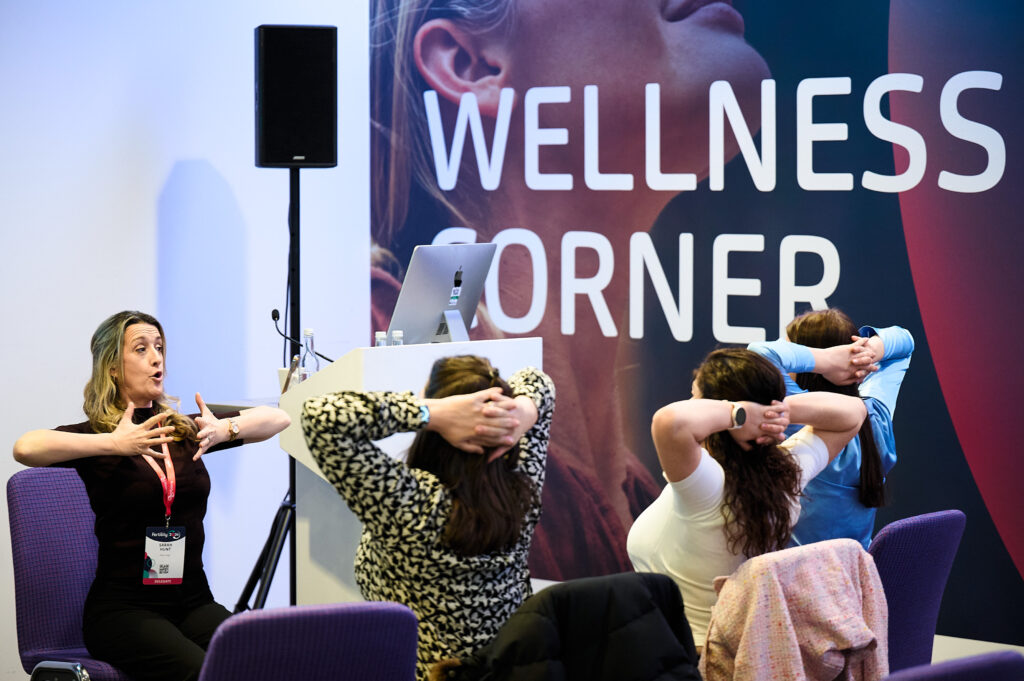
The Conference is divided into a series of smaller boutique rooms to listen to an enormous range of topics. Almost all of the topics focus on new tech, and new process. Every room is packed. There are several Panel Sessions, but the formula is the same, with a Moderator showing complicated slides on a screen. And for those who need to take time out – there are quiet areas dotted around.
Yes, this is a meeting point for people to get to know each other, and it may be the real reason that people get together. The synergy of those one to one conversations clearly benefits the greater good.
But there is also a commercial focus
If Fertility 2026 is the gold standard so to say, for those engaged in Fertility, to meet up, then it has to be, by definition, the place to launch new commercially viable, services. For Jonny East, Founder of the start-up “MaleBoxHealth”, – this event was their second time – their first was a year ago-, when their company was just a few weeks old: “We used the first visit to learn from our market, and perfect what we were offering, in time for this year”, he told me over a beer afterwards.
I bump into a friend of mine from the Fertility Fusion clinics in the North West. “I always use this to find out what’s going on!” she says, smiling. It is clearly time to end the day, I saunter over to the cloakroom, pick up my coat and bag.
———————-